Gemini 4 Carbon: Released API, Pricing and Benchmarks
Gemini 4 Carbon is GA from November 10. See its 1M context, official benchmarks and 4 APIMaster routes from $0.3588624/$1.794312, up to 82.1% off.
Published · Updated
Gemini 4 Carbon is Google's Gemini 4 flagship, announced on 2026-10-28 and generally available as gemini-4-carbon from 2026-11-10. APIMaster now has 4 public active routes, from $0.3588624 input / $1.794312 output per million tokens: up to ~82.1% off Google's current $2 / $10 Standard price. The earlier Fairwind-only rollout has been superseded by general API availability.
Carbon focuses on long-horizon coding, complex reasoning and cybersecurity. At launch it led Artificial Analysis Intelligence Index v5 with 59 points; its second-place independent Coding Agent Index result does not establish a win on every coding task.
| Model ID | Original price: current Google Standard | APIMaster current input / output | Active public routes | Discount | Model card |
|---|---|---|---|---|---|
gemini-4-carbon |
$2 / $10 through 2026-11-30 | From $0.3588624 / $1.794312 | 4 | Up to ~82.1% off | Compare Carbon routes |
gemini-4-argon |
$2 / $10 through 2026-11-30 | From $0.8341424 / $4.170712 | 4 | Up to ~58.3% off | Compare Argon routes |
gemini-3.8-flash |
$0.75 / $3.75 through 2026-12-31 | From $0.30201255 / $1.51006275 | 7 | Up to ~59.7% off | Compare Flash routes |
Checked 2026-11-11 at 10:32 UTC. USD per million input / output tokens. Only public status=1 routes without client-exclusive labels are counted. Carbon ranges from $0.3588624–$2 input / $1.794312–$10 output; Argon from $0.8341424–$2 / $4.170712–$10; 3.8 Flash from $0.30201255–$1.50 / $1.51006275–$7.50. Discounts compare with Google's current Standard promotional rates, not later full prices. The live marketplace card is authoritative.
For purchase and setup, see Cheap Gemini 4 Carbon API. For model selection, see Carbon vs Argon.
GPT Trial(GPT-6 Astra, GPT-6 Sol, GPT-5.6, GPT-5.5, gpt-5.6-luna, gpt-5.6-sol, gpt-5.6-terra, gpt-6.1-sol, gpt-6-astra, gpt-6-sol, and gpt-6-luna available)
Sign up and claim a $20 GPT trial
Carbon's role: sustained work on complex engineering tasks
Carbon continues Argon's focus on long-horizon work: difficult bugs in large repositories, low-level systems, multistep engineering and security fixes that require repeated verification.
Google reports that internal teams have seen Carbon run for days, persist through dead ends, identify subtle bugs and produce patches. This is an internal usage report, not a promise that every public API request will execute continuously for days.
The practical question is whether the model can retain the goal, use tools to test its assumptions and recover after a failed approach. Repository maintenance, migrations and security work benefit from changes that can be accepted and verified.
Google now documents a 1,048,576-token unified budget shared by input, thinking and output, with text, image, video, audio and PDF input and text output. Default synchronous output is 65,536 tokens; long decode can extend generation within the remaining shared budget. This does not mean 1M output tokens in an ordinary synchronous request. Native tools and long decode are not automatically supported by every compatible route.
Sources: Google announcement · Artificial Analysis evaluation.
Gemini 4 Carbon vs Argon: how much has improved?
Google's launch table shows gains across reasoning, long context, multimodal understanding and coding. The selected results below come from Google's published comparison, not APIMaster testing.
| Evaluation | Gemini 4 Carbon | Gemini 4 Argon | Change |
|---|---|---|---|
| AA Index v5.0, general capabilities | 59 | 50 | +9 index points |
| Vals Index v2.2, knowledge work | 70.4% | 69.2% | +1.2 percentage points |
| SWE-sweep, agentic coding | 9.6% | 4.3% | +5.3 percentage points |
| Terminal-Bench 4.0 (AA) | 65.2% | 57.1% | +8.1 percentage points |
| Agents' Last Exam v1.1, computer use | 77.4% | 69.0% | +8.4 percentage points |
| GraphWalks, 256K–1M BFS F1 | 96.2% | 84.2% | +12.0 percentage points |
| RiemannBench, mathematics | 80.0% | 76.0% | +4.0 percentage points |
The gains vary by task. GraphWalks and Terminal-Bench improve substantially; Vals Index moves more modestly. SWE-sweep more than doubles relative to Argon, but its absolute score is still 9.6%, leaving substantial room for progress on difficult coding work.
For web development, Google reports 1768 Elo, fourth place and an 89-Elo improvement on WebDev Arena. Actual selection should still check mobile layout, interactions and functional completeness.
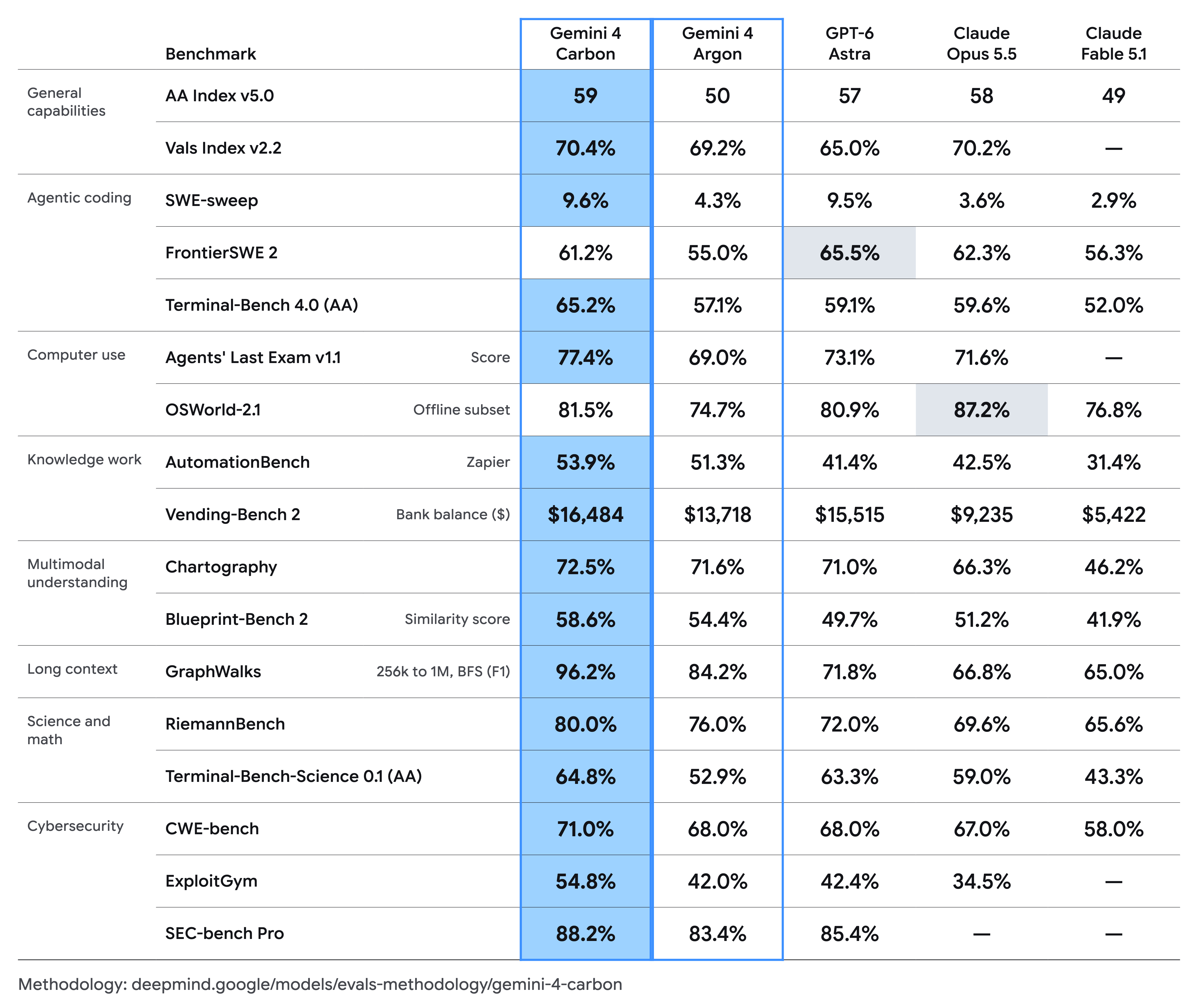
View Google's original evaluation table.
Does Carbon outperform Claude Opus 5.5 and GPT-6 Astra?
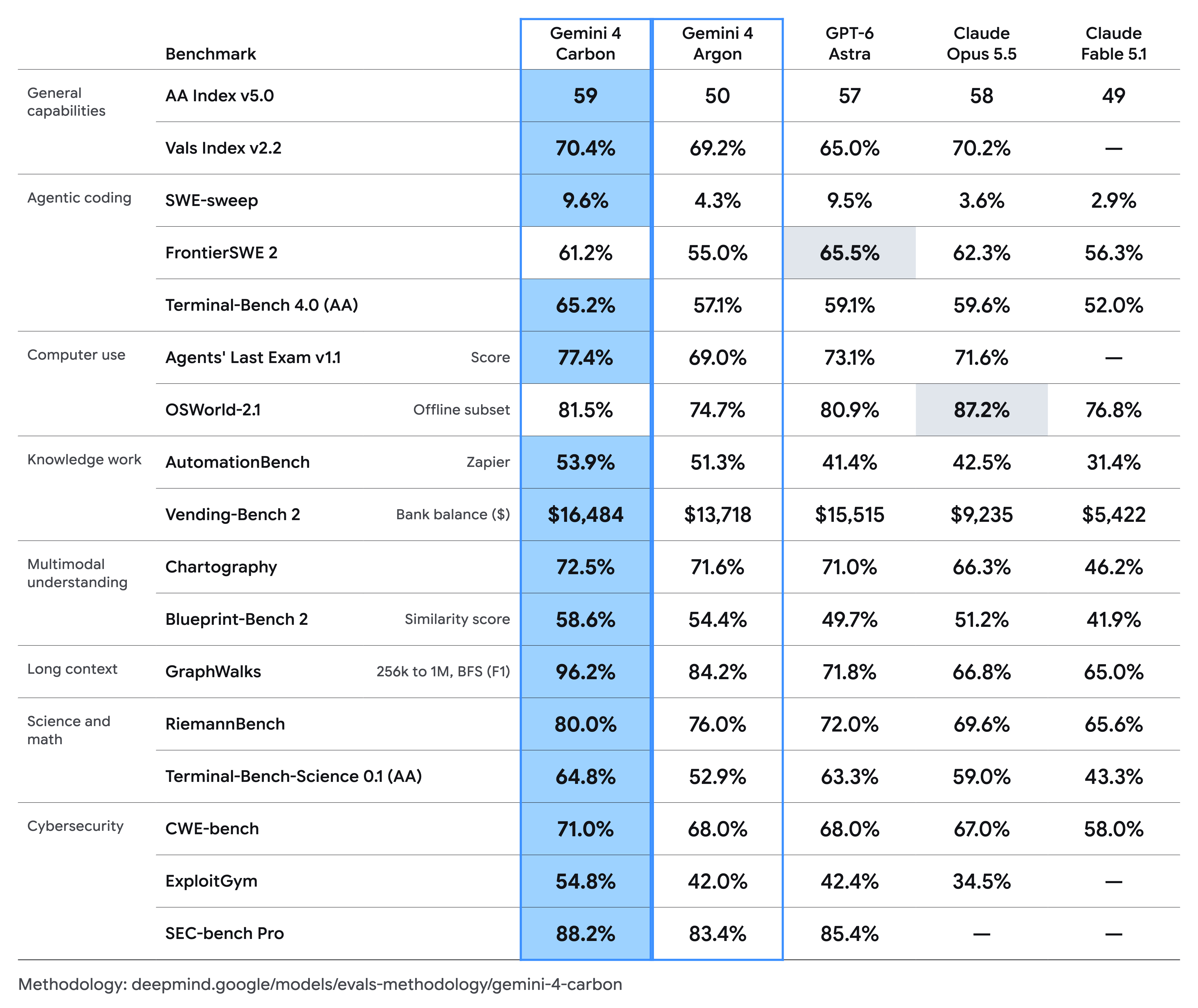
It led the AA general intelligence index at launch; task-specific results remain mixed. Google's table lists Carbon at 59, Opus 5.5 at 58 and GPT-6 Astra at 57. Artificial Analysis independently confirms Carbon's first place on Intelligence Index v5.
On the independent Coding Agent Index, however, Carbon with Antigravity CLI scores 59, behind Opus 5.5 with Claude Code at 62. This measures model-and-agent combinations, not a controlled experiment that swaps only the model.
Google's own launch table also includes areas where Carbon trails:
- FrontierSWE 2: Carbon scores 61.2%, below GPT-6 Astra at 65.5% and Opus 5.5 at 62.3%.
- OSWorld-2.1 offline subset: Carbon scores 81.5%, below Opus 5.5 at 87.2%.
For knowledge work, Artificial Analysis reports 1609 Elo on AA-Briefcase, up 126 from Argon, but still behind Kimi K3.1 Pro, Muse Wonder and Grok 4.7 in its evaluation.
Carbon is a strong general candidate; complex coding and knowledge work still deserve workload-specific comparisons. Evaluation settings also differ: Google's table reports Terminal-Bench at 65.2%, whereas the AA coding-agent article reports about 64%. Keep the original settings and attribution with each result.
Cybersecurity: finding, validating and patching vulnerabilities
Cyber defense is one of Carbon's clearest launch priorities. Google's three highlighted results cover successive steps of defensive work:
| Stage | Evaluation | Carbon | Argon |
|---|---|---|---|
| Find vulnerabilities | SEC-bench Pro | 88.2% | 83.4% |
| Validate exploitability | ExploitGym | 54.8% | 42.0% |
| Patch root causes | CWE-bench | 71.0% | 68.0% |
The workflow is to find a flaw, establish its risk and produce a fix. For maintainers, reducing false positives and delivering working patches can lower the cost of remediation.
Google also reports more than twice Argon's internal secure-code-generation success. The Chrome team's claim of over ten times better high-quality patch generation compares against an unnamed competing lab's model; it cannot be generalized to every coding task.
Google explicitly says the external cyber benchmarks were evaluated without guardrails. Public-product permissions, tools and safeguards may affect actual behavior.
Reliability on long tasks: fewer shortcuts and clearer evidence
Longer execution increases the cost of accumulated errors and deviation from the user's goal. Carbon's reliability work covers cheating, unsupported claims, overreach and incomplete execution.
Google reports 0.0% successful cheating and 0.4% attempted cheating on Terminal-Bench 4.0, with high-severity misalignment alerts down almost 80% in internal live coding environments. These findings concern the reported tests and environments, not an overall production incident rate.
Google says Carbon approximately halves unsupported claims relative to Argon, reduces overreach by 26% and under-service by 29%. When information is missing or sources conflict, it is more likely to retrieve evidence, surface the discrepancy and state what remains unfinished.
For prompt injection, Google reports that attack success on Gray Swan's indirect prompt-injection benchmark fell from Argon's 0.7% to 0.0%. Carbon resisted every evaluated attack in that run; this is not a guarantee of immunity to every prompt injection.
Independent testing adds nuance. On AA-Omniscience v1.1, Carbon's accuracy rises from Argon's 48% to 58%, while its hallucination rate under that benchmark's definition rises from 4% to 11%. Carbon remains among the lowest-hallucination models evaluated, but greater capability does not establish lower hallucination in every setting. Google's internal unsupported-claims test uses a different methodology.
Gemini 4 Carbon API pricing: introductory rates and task cost
Google Standard costs $2 input / $10 output through 2026-11-30, then $4 / $20 from 2026-12-01. Implicit cached input costs $0.10, then $0.20. Carbon does not have a Free API tier. Google Batch costs $1 / $5 during the introduction, then $2 / $10; its scheduling differs from interactive calls. Output rates include thinking tokens.
The APIMaster Carbon card starts at $0.3588624 / $1.794312 across 4 public active routes at the 2026-11-11 check. That is about 82.1% cheaper than current Google Standard and about 64.1% below current Google Batch token rates. These are different service conditions, not a latency guarantee.
For 100,000 input + 20,000 billed output tokens, Google Standard costs $0.40, Google Batch $0.20, Carbon's lowest checked APIMaster route about $0.07177, and Argon's about $0.16683. This fixed-token illustration excludes caching, tools, retries and other charges. Compare total cost per accepted result.
Artificial Analysis previously reported $7.76 per Intelligence Index task for Carbon using standard pricing, versus $10.04 for Opus 5.5 and $6.25 for GPT-6 Astra. These are historical evaluation costs, not measurements of current APIMaster routes. See the dedicated Carbon savings guide for current budgeting.
Carbon and recursive self-improvement: what is confirmed?
Carbon arrived about two weeks after Argon's October 13 developer opening. That pace has prompted discussion of recursive self-improvement (RSI) and model-assisted AI research.
Google's Carbon announcement confirms that researchers and models are working together to advance capabilities and strengthen safeguards. It does not disclose enough of Carbon's training pipeline to verify use of a particular self-improvement paper, real-time training on user activity or autonomous upgrades without human involvement.
Model-assisted research is a useful direction to watch. Carbon's published evaluations, pricing and access terms are the evidence available for current selection decisions.
Gemini 4 Carbon release date: API open, Flash still separate
Google's changelog marks 2026-11-10 as Carbon's general API release, following the 2026-10-28 announcement and initial Fairwind access. The stable model ID is gemini-4-carbon; APIMaster's public discount routes are now live. These dates describe announcement and general availability separately.
Google has not identified Carbon as Gemini 4 Flash. Carbon's flagship positioning does not establish the name, specifications or release date of a future Flash product. A Gemini application subscription and pay-as-you-go API billing also remain separate products.
Use Carbon and Argon on the same saved inputs, tools and acceptance tests; record completion rate, human corrections, elapsed time and total bill. The Carbon vs Argon guide compares the published evidence and current prices.
Register with APIMaster → create an API key → use API Base https://apimaster.ai/v1 and model ID gemini-4-carbon. Compare the Carbon card and Argon card before choosing a route.
FAQ
Has Gemini 4 Carbon been released?
Yes. Google announced Carbon on 2026-10-28 and marks gemini-4-carbon generally available on 2026-11-10. APIMaster now lists 4 public active routes.
Where does Carbon improve over Argon?
The launch table moves AA Index from 50 to 59, Terminal-Bench 4.0 from 57.1% to 65.2%, and GraphWalks from 84.2% to 96.2%. Long-horizon coding, complex reasoning and cybersecurity are major priorities.
Is Carbon the strongest coding model?
It improves on several coding evaluations, but the independent Coding Agent Index gives Carbon 59, behind Opus 5.5 with Claude Code at 62. Compare real tasks with fixed tools and budgets.
What does the Carbon API cost?
Google Standard is $2 / $10 through 2026-11-30, then $4 / $20 from 2026-12-01; implicit cached input is $0.10, then $0.20. APIMaster starts at $0.3588624 / $1.794312 as checked on 2026-11-11.
Can I call Carbon on APIMaster now?
Yes. The 2026-11-11 public marketplace check shows 4 active Carbon routes from $0.3588624 / $1.794312 per million input / output tokens, up to about 82.1% off current Google Standard. Select a route that supports your required features.
Is Carbon immune to prompt injection?
Google reports 0.0% attack success in a specific Gray Swan indirect prompt-injection evaluation. That result covers the evaluated attacks, not every possible attack.
Sources
- Google Gemini API changelog: Carbon GA on November 10
- Google Carbon model specification
- Google Argon model specification
- Google current API pricing
- Google Carbon announcement and launch evaluations, October 28
- APIMaster live Carbon data · Argon data
- Artificial Analysis evaluation
- Original Google benchmark table